Showing posts with label empowerment. Show all posts
Showing posts with label empowerment. Show all posts
Follow Friday - #IAmMalala
Labels:
#ff,
#followfriday,
campaign,
education,
empowerment,
ff,
follow,
follow friday,
friday,
girls,
human rights,
i am malala,
inspirational,
malala,
malala yousafzai,
pakistan,
women
·

 I recently read the biography of a young woman called Malala Yousafzai. She is 16, and is the most inspirational human rights campaigner I have ever seen.
Growing up in Pakistan, she frequently campaigned for and encouraged girls to stay in education - she did not see why someone's gender should dictate whether they went to school or not. And as a result of her campaigning, she was shot in the face by the Taliban on her way to school.
She was transferred to Queen Elizabeth Hospital in Birmingham, and luckily survived the ordeal. Her campaign grew, and she went on to speak at the United Nations to call for worldwide access to education on her 16th birthday.
Follow Friday - #EverydaySexism
Labels:
#followfriday,
blog,
empowerment,
everyday sexism,
feminism,
feminist,
follow,
follow friday,
friday,
girls,
heartbreaking,
laura bates,
men,
objectification,
sexism,
stories,
story,
women
·
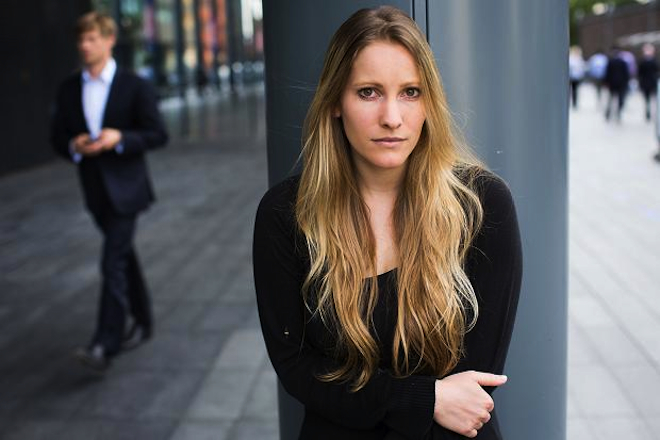 The Everyday Sexism Project is a blog started by a woman and feminist writer named Laura Bates in 2012. Growing tired of hearing how feminism is not needed in everyday life, she started the project to show just how much sexism still exists nowadays.
Women and men can anonymously submit their entries on the website, on twitter or via email, and tell their stories of sexism encountered in everyday life. Their stories are, unfortunately, easy to relate for a young woman in today's society, and show just how common and normalised sexism has become. Some of the stories are so heartbreaking, and really make me angry and passionate about changing the way we see women in society.
Check it out on their website and twitter. Laura has also just released a book about the project, which you can find on Amazon, and has also done a TED talk about her project, which you can watch below.
Sexism explained.
Labels:
empowerment,
equality,
explanation,
female,
feminism,
feminist,
gender,
gender roles,
male,
men,
psychology,
relationships,
sexism,
social psychology,
women
·
Although sexism has been around for a long time, the
official psychological term “ambivalent sexism” was not coined until 1996 by
Dr. Peter Glick and Dr. Susan Fiske. They proposed that sexism can be split
into two distinct categories: hostile and benevolent sexism.
Hostile sexism
This is the type of sexism that everyone stereotypically
thinks of as sexist attitudes, such as that women are weak, incompetent and
sexually manipulative. It views them as inferior to men and objectifies them as
sexual objects to be used merely for male pleasure. This includes things like
telling offensive jokes, domestic violence against women and catcalling at
women in the street.
 |
| image source: instagram @generationsfinestt |

Examples of hostile sexism from
Glick and Fiske’s sexism scale (The Ambivalent Sexism Inventory) include:
“Once a woman gets a man to
commit to her, she usually tries to put him on a tight leash.”
“When women lose to men in a fair
competition, they typically complain about being discriminated again.”
“Many women are
actually seeking special favors, such as hiring policies that favour them over
men, under the guise of asking for "equality."”
Benevolent sexism
This is a much more subtle type of sexism that is sometimes rephrased as "chivalry." It is often
brushed off by people as being “not really sexist.” This involves
praising women’s traditionally feminine qualities and encouraging traditional
gender roles. This includes things like opening doors for women, carrying
things for them and buying gifts for girlfriends/wives out of the blue.
Although all of these things seem like nice things to do, in the context of men
consistently doing these things for women, they imply that women need men to
take care of them and look after them. This stereotypes women as the weaker
sex, and encourages them to stay in inferior societal positions to men.
Examples of
benevolent sexism from Glick and Fiske’s scale include:
“Women should be cherished and protected by
men.”
“A good woman should be set on a
pedestal by her man.”
“Men
should be willing to sacrifice their own well being in order to provide
financially for the women in their lives.”
The topic of sexism - particularly benevolent sexism - frequently comes up in discussion between me and my boyfriend. He argues that things like holding doors for someone, buying presents, wanting to provide for financially for them and wanting to protect them aren't sexist, they're just the sort of things you do for someone you love, male or female. And I can see his point - and I know he is does not truly endorse benevolent sexism or we would've broken up a long time ago! And despite it being the opposite of traditional gender roles, I also like to buy him gifts, pay for our meals out together, hold doors for him.
 |
| image source: instagram @generationsfinestt |
I think the problem arises with people's expectations of these things; females expect these things from their male partners more so than the males would expect from their female partners. In fact, an article published last year by Hammond and Overall (2013) showed just how bad benevolent sexism can be for relationships. When women hold benevolently sexist views, they are more likely to experience more sensitivity about problems in the relationship, a faster decline in relationship satisfaction when experiencing these problems and more hurtful partner behaviour. The authors concluded that women who endorse benevolent sexism are quite frankly "vulnerable within their relationships."
After a lot of thinking and many discussions with my boyfriend about it, my conclusion is that it's perfectly acceptable to hold the door open for your girlfriend - as long as she holds it for you sometimes too.
References:
Hammond M.D.; Overall, N. C. (2013) When relationships do not live up to benevolent ideals: Women's benevolent sexism and sensitivity to relationship problems. European Journal of Social Psychology, 43(3), 212-223. doi: 10.1002/ejsp.1939
Glick, P.; Fiske, S. T. (1996) The Ambivalent Sexism Inventory: Differentiating hostile and benevolent sexism. Journal of Personality and Social Psychology, 70(3), 491-512. doi: 10.1037/0022-3514.70.3.491
10 ways to be happier
Here are a few things that I try and to do pick myself up when I'm having a bad day (or week... or month...)

1. Go outside. Often, when I'm saying goodbye to my boyfriend after he comes to stay for the weekend, I'll be in my room crying and won't be able to stop. As soon as we go outside to start walking him to the train station I always feel immediately a little more positive about the situation. The same goes for if I'm feeling down and I'm just in my house on my own - if I force myself to get out and go to uni or into town or even just to the shop to get some milk, I always feel better having been outside in the fresh air.
2. Smile. Okay it's an obvious one, but Psychology studies have shown us time and time again that if you smile while you're doing something, you enjoy it more (for an example, check out one of the original papers on this topic by Strack, Martin and Stepper, 1988). So even if you're stuck at work all day and you're bored and it's raining, give the next customer that walks in a huge welcoming smile, and you will certainly improve your mood, and probably theirs too.


3. Notice the little things. I only truly notice and appreciate the little things when I'm on my own, but it does often help me feel more grounded and secure in my life. If you take time each day to notice something positive, you'll find you probably have a more positive outlook for the whole day. It could be something as little as noticing a pretty flower or a nice pattern in the clouds or a cute puppy on the train, but it will certainly give you a better chance at having a happier day.


4. Appreciate the good. When things seem to be all going wrong, the best thing to do is look for the silver lining. And there always, always is one. You live too far from your family to see them? At least you have a family that want to see you! You don't like your job? At least you have one! And, like me - you hate saying goodbye to your boyfriend every weekend?! At least you have a boyfriend that loves you and comes to visit! Although it seems hard, try and be grateful for the things you do have rather than resenting the things you don't.
5. Be kind to people. Nothing beats that feeling after you've done something nice for someone without expecting anything in return, so use this as a way to improve your mood when you're having a bad day. Even something small like complimenting your friend or buying your housemate her favourite chocolate bar on your way home can give you a real buzz of happiness knowing that you've done something nice when you didn't have to.
6. Exercise. I know it seems like the last thing you want to do when you're feeling down, but honestly even just going out for a 5 minutes walk will make you feel better. If you're feeling a little more adventurous, go for something a bit more challenging, e.g. running, cycling, yoga, swimming, pilates, dancing... The possibilities are endless, and if you've never tried something like yoga before, just look it up on youtube for a beginners video tutorial.


7. Baking. Ok it might just be me on this one, but I find baking and cooking really stress relieving. During exam period I do so much baking I think my housemates and I put on about a stone each. Maybe it's just because I'm focusing on something else other than what's making me stressed, but I really do find it helpful. If you're not that confident in the kitchen, just get a packet cookie or cupcake mix, or look up an easy recipe online.
8. Spring cleaning. Maybe this one is again just allowing me to focus on something other than what's stressing me out, but I find that once I really get into tidying and cleaning my house, I'm not really thinking about anything else. I feel like I have a task to do, and once it's done I feel proud that I've accomplished something for the day, and don't feel as bad any more!

9. Nap. Ok maybe this is because I'm a student, but naps do really help you feel better. When you've got 2 essays and 4 exams all due in this week and you're so stressed about them all you don't know what to do first, have a nap. Even just lay down with your eyes closed and rest. Just for half an hour. 45 minutes at the absolute most (otherwise it's not a nap, it's a full on sleep). Then when you wake up you'll feel refreshed and hopefully in a different mood from earlier.

10. Hug one of your mates. Or mum. Or dad. Or boyfriend. Or girlfriend. Anyone really. Maybe even a pet. Contact with others causes happier brain chemistry, so just say to someone that you're feeling down and need a hug. Any true friend will be happy to help :)
I need feminism because...
Just a few of my fave images from the "I need feminism because" / "who needs feminism?" projects. Some of them shocking, some funny and some heartbreaking...

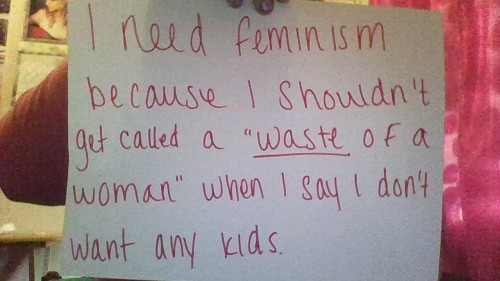
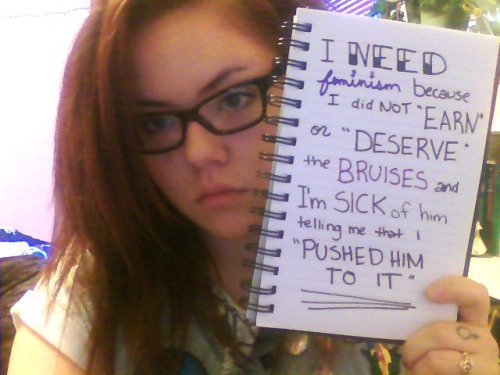


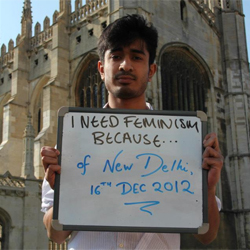


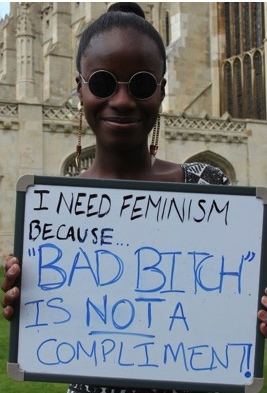


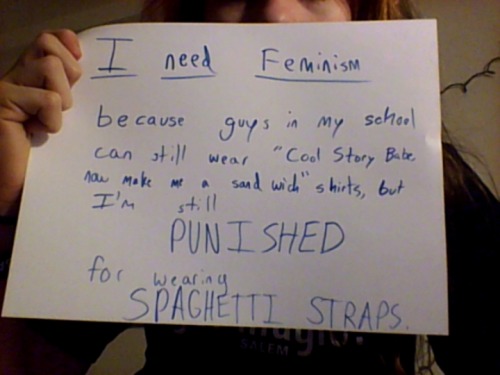
Basically...

why has feminism become a negative concept?
Labels:
empowerment,
equality,
female,
feminism,
feminist,
girls,
objectification,
psychology,
rape myth acceptance,
thoughts,
victim blaming,
women
·

This article gives a good overview on how the word feminism originated and developed into what we think of it today (http://vomnck.wordpress.com/2013/03/04/the-negative-connotation-of-the-word-feminism-explained/).
People often misinterpret what feminism about, thinking (wrongly!) that feminists want power over men. I cannot emphasise enough that this. is. not. feminism. Feminism is about equality. Feminism means being able to look at someone and see them for the person they are rather than making assumptions about them based on their gender. I, along with many women, do not want to live my life as a self-fulfilling prophecy that I will not be as successful as my brothers and father and uncles and male cousins, that I will not earn as much as my husband, that I will want to have children, that I will stay home and look after said children because it is my "natural instinct."
It has taken me a long time and several years of studying the psychology of sexism and related concepts at university to come to realise that this is what feminism is truly about. It's taken nearly 4 years for me to disentangle the mess of assumptions about feminism that aren't true, in order for me to realise who I truly am and finally see that feminism is not a bad thing at all! Really, I ever want my daughters to grow up to be with the same opportunities as my sons, I need feminism.
Subscribe to:
Posts (Atom)